

Games through a stranger’s notes: Final Fantasy I
Another day at Gamemakerston Academy begins.

Hi friends. Let’s try a new way to dissect games and study their strengths and weaknesses. Even if you have not played the games mentioned, read on for some food for thought and come say hi in the comments :D
In this series, we’ll pretend we go to the same game development school: Gamemakerston Academy of Interactive Arts.
This morning, we came across a mysterious stranger’s lost notebook.
Curiosity takes hold of us and we decide to peek inside. Let’s see what our classmate has been studying and their key takeaways about what makes a game great.

April 10th, 2026
Is it possible to be objective about a game, when you’ve only played a remastered version that was released 34 years after the original?
Maybe not, but I’ll do my best to approach the game with only one intention: understanding what makes a game reach greatness.
Final Fantasy I: Pixel Remaster
Genre: RPG
Original’s release year: 1987
Pixel Remaster’s release year: 2021
Played on: Switch
Made by: Square Enix
The original was loved as:
❤️A love letter to a classic DnD homebrew campaign.
❤️A game inviting you to use your imagination, giving you space to create your own stories even as a multiplayer experience.
A game where history meets modernity
The iconicity.
The art.
The birth of a cultural phenomenon.
The adorable White Mage.

In summary
-It took me about 14 hours to complete. Most of them did not feel like a breeze.
-Too many encounters (apparently I could have turned them off???).
-Missing a strong story hook. Nothing felt urgent. I had to save people just because the prophecy said “I had to”.
Why?
Different times, different standards. The game was made to entertain an audience with different attention spans & time constraints.
-This is a very, very classic RPG game. If you like simplicity, you’ll find it charming. The characters are blank canvases, the world does not drown you in lore, there are loose ends and unexplored stories that hint at the world’s depth.
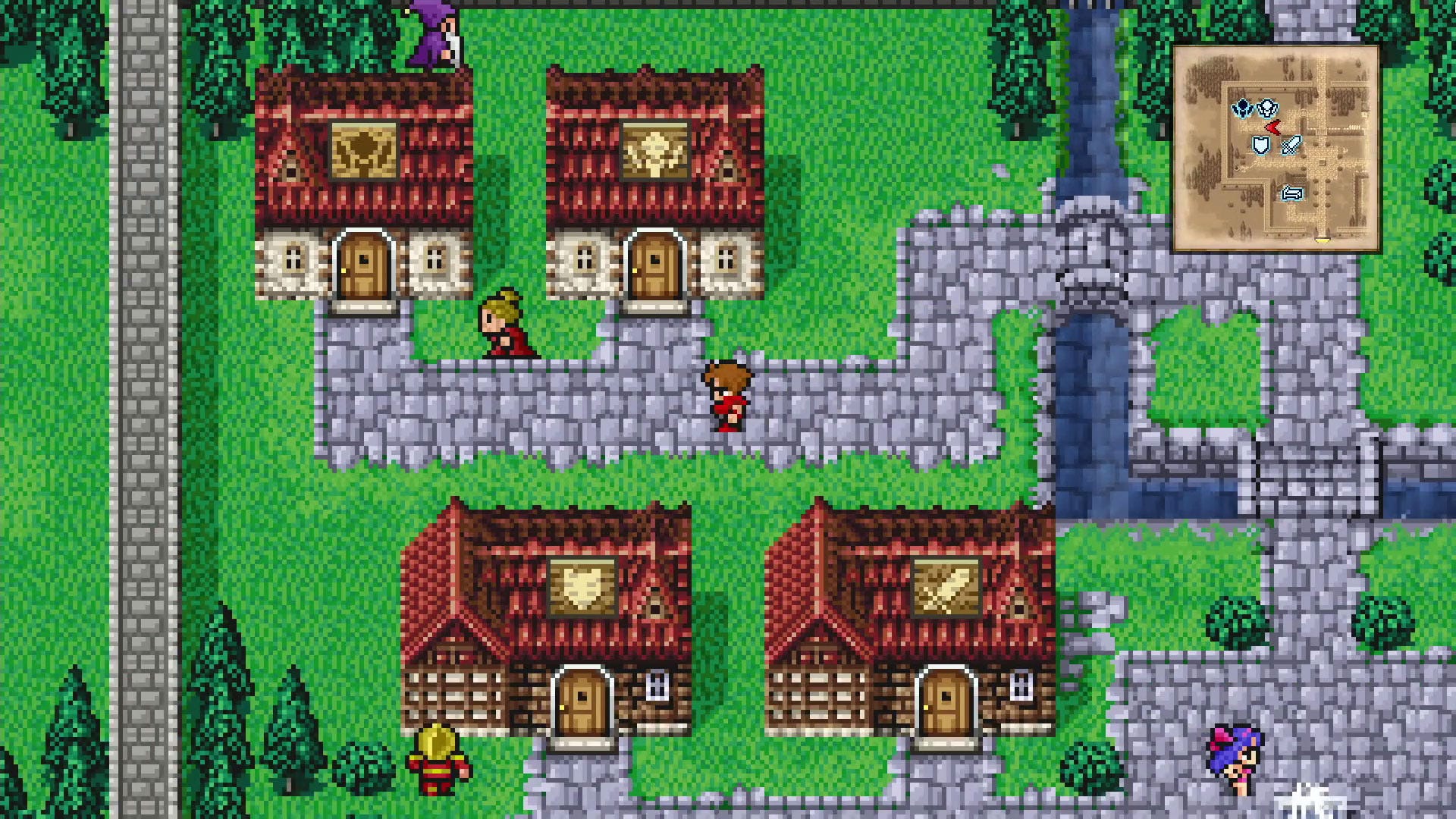
-I won’t be too judgmental of what was fun in the 80s. The genre and the anthology have evolved and reinvented themselves. If I’d played it back then, it would have changed my world and ignited my imagination.
Now, it felt like a must-play to deepen my ✨cultural literacy✨.
But for the sake of making a game for today’s players, I will differentiate between historical greatness and modern expectations. Let’s see what makes a game’s design hold up, and where it might fall short.
Narrative pacing
The MOST emotional moment was the ending. It took me 14 hours to feel something real about the world.
That was a bit too late.
(But I DID cry.)
I knew the game wanted me to feel like I had to save a world, I just had no reason to care about it.
On the other hand, Final Fantasy II was a lot more strategic about pacing emotional investment (more on that in my phone’s notes, to be added in this notebook later today).
»»» Quick brainstorm: What would have worked better as an intro?
-Starting the game with a missing party member.
-Being rescued by an NPC, deciding to help their world in return.
-Refusing the prophecy until you have no choice but to accept it.
-Anything instead of “Hey, you just APPEARED, now get to work”:
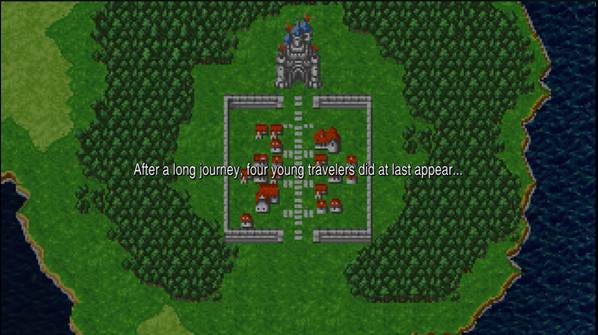
Things that fostered emotional connection:
-Cute NPCs: I will protect you and all your 12 pixels.
-Curiosity about new spells/weapons: Each one is a mini reward.
-The music: even when my story felt executional rather than heroic, the music maintained the right tone.
(I vow to never make a game with flat music, EVER. Music travels faster than any mechanic and any story and can prepare your player’s heart to be shattered and reshaped as you please 😊)
Epic moments
Class upgrade. When your party of babies turns into a group of beasts.
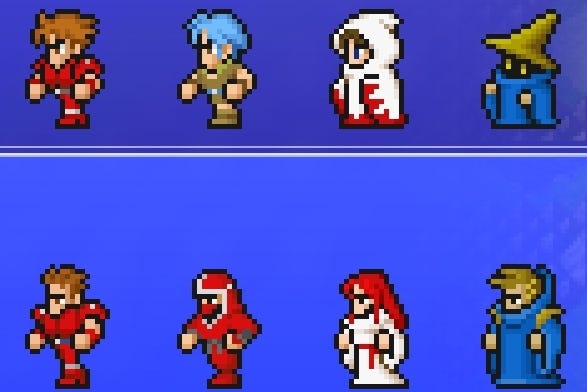
I was really looking forward to it, so I put up with a lot of encounters and blazed my way through the game just to see it happen.
🔮I regard it as a “Foreseeable Epic Moment (FEM)”: the player knows it’s going to happen, and it fuels their passion, helping them disregard (or learn to love) the game’s weak spots to get to the good stuff.
🔮Maybe it’s best to spread those moments out, instead of cramming them into a single instance. Dangle the carrot a little bit.
🔮Key terms to look up: delayed payoff, player tolerance for friction, motivation as a design tool, narrative payoffs.
When the game’s voice finally shines through.
The game’s true voice and philosophy took a while to appear. It just felt too silent (or I was the wrong kind of listener?).
The ending text was actually a great reward, because it was beautifully written and I think about it still. Two single lines have made their way into my heart and I feel damn good about myself.
❗Does your/my game have that kind of writing? Does it need it? Why/Why not? Give your stuff some extra love before you ship.
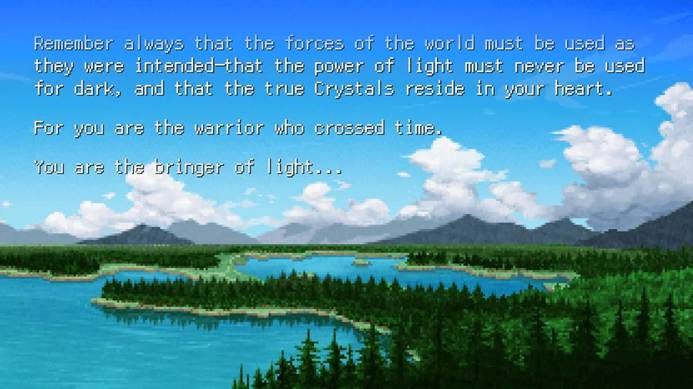
❗When should a game reveal its voice?
In Narrative Design for Indies, Edwin McRae makes a point that instantly elevates a narrative designer’s toolset:
“If you don’t have characters in your game, then your game is the character”.
This refers to a specific category of games, but later he elaborates:
“Anything with a heart is alive in some way, and if it’s alive, even metaphorically, it has to be a character.”
…
“We humans are so in love with the very concept of ‘humanity’, that we expect everything else to be human as well. We’re like Tom Hanks, stranded on an island, painting a face on a volleyball so that we have someone to talk to.”
Personally, any written word that is not said by a character in a game, is said by the game itself.
MAKE IT MATTER.
The world has charm and heart, and that’s what I needed early on.
So, to answer the initial question:
A game should never “reveal” its voice: it should simply be there from the start. If its personality is “generic storyteller”, it’s going to show and strain the player-game relationship.
One thing I would change
Lack of need for strategy.
Maybe the original game was much more brutal, but now most battles require zero thinking.
I would have liked some reason to experiment with my spells and powers, which I had to do only in the final boss battle. I spent time planning and teaching each character a unique set of spells that I seldom used.
»»»I would try designing mini bosses with unique attributes/abilities, just to nudge the player to think outside the box. FFII did this and it aced it in my opinion.
Man… I think I’m onto something here. I better not lose this notebook.
On the rare occasion I misplace it and you find it, please return it to the reception desk where I’ll be frantically searching for it 😊
Welp, you heard the stranger. Let’s return the notebook and continue our discussion in the comments!
See you in the next post,
Yukisia
I recently played the original FFI. It is a bit tougher than what you described from the pixel remaster, but not hard. At least not combat-wise. Navigation and finding where you need to go was a struggle that occasionally became annoying. There was also one dungeon that I had an encounter literally every other step. That was a slog. My one experience with the remasters (FFIII) immediately turned me off because the text boxes looked so cheap. The text is so small (maybe that could be changed?) that the blue boxes looked too big and poorly designed. I know they were aiming to emulate the original design, but those boxes were filled side to side with the text. It was just so much more aesthetically pleasing.